


Full article
Generative AI & Neuromarketing
We live in an age of guess and test marketing, which is approaching its definitive end. Traditionally, marketing has made ample use of feedback collected after purchase, self-reports, and A/B testing. Yet, such methods necessarily involve human rationalization since about 95% of purchase decisions happen subconsciously, and only later do people create logical explanations for their choices.
Here comes 2026, when the fusion of Generative AI and Neuromarketing enables marketers to turn consumer insights into a predictive science.
The Tech Stack
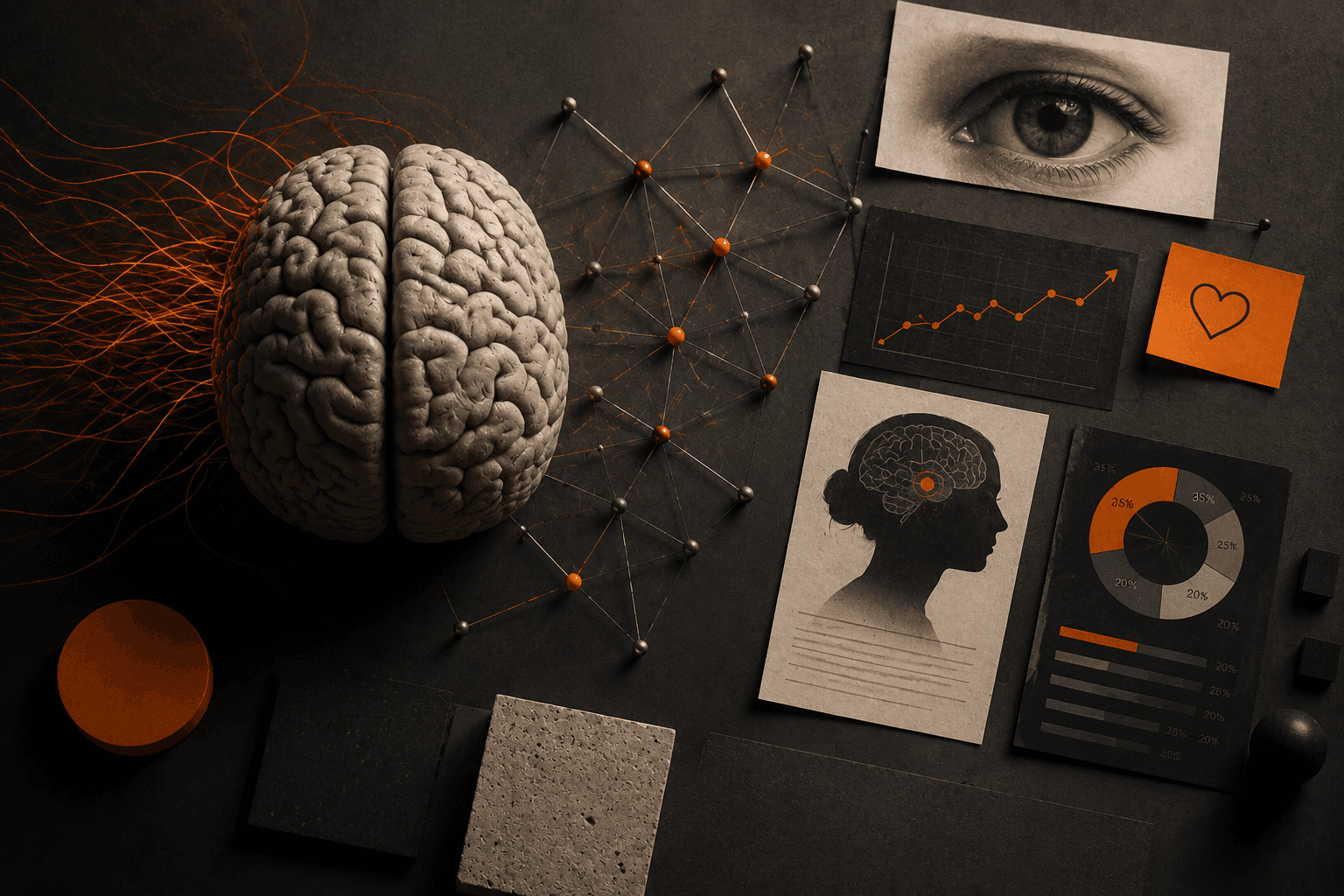
Going Under the Skin Traditionally, neuromarketing was an academic practice or a costly luxury for big corporations due to the bulky nature of functional Magnetic Resonance Imaging (fMRI) and wired EEG technology. Today, thanks to cloud analytics, small wearable devices, and automated facial coding, one can analyze what happens in the depths of people’s consciousness. With biometrics and a conditional Generative AI algorithm, it is possible to design a closed emotional loop. Such system usually consists of some tech layers in operation
Sensing Module: Light-weight consumer devices (such as integrated dry-EEG sensors or high-resolution cameras monitoring eye movement) pick up physiological responses in real time. Interpretation Module: Multi-modal streams picked up by these devices are analyzed using deep learning algorithms, with changes in skin conductance and/or micro-expressions translated immediately into an emotional state vector (representing psychological valence, cognitive load, and attention).
Generative AI Module: An LLM or diffusion model informed by the emotional vector receives the input. Upon detection of cognitive friction or increased frustration from the interpretation module, the generative model will adapt immediately, either by simplifying the design, changing the tone of the text or altering visual contrast.
Delivery Module : Adapted interfaces and creative content are delivered instantaneously, forming a feedback loop optimized for human psychology. Neural Fluency Design Principles.
At the heart of this process is the idea of designing with neural fluency in mind—an optimization of neural processing efficiency that does not overwhelm the brain with stimuli. Instead, generative frameworks are being increasingly designed with the goal of creating cognitive processes specifically triggered by the interface itself.
Module for Sensing : This involves the use of lightweight devices in consumer technology such as integrated dry-EEG sensors or high-quality webcams which capture eye movements in real time to identify their reactions.
Module for Interpretation : These multi-modality data are interpreted in real time using deep learning algorithms that will convert the skin conductivity readings and micro-expressions into vectors of an emotional state (psychological valence, cognitive workload, and focus).
Module for Generative AI : In this step, an AI language model transformer or diffusion model is used, and based on the analysis from the interpretation stage, when cognitive conflict or frustration is detected by the interpretation module, the generator AI will respond immediately to reduce visual complexity or change the tone of texts.
The Importance of Designing for Neural Fluency
One of the key ideas of this fusion includes neural fluency—the ability to minimize the cognitive effort necessary for the brain to make sense of incoming information. Rather than overwhelming users with unstructured stimulus bombardments, new-generation frameworks are being fine-tuned using principles of neuro-design to elicit certain kinds of cognitive response from users’ brains.
Our brain tends to seek visual familiarity. New algorithms can audit and enhance the hierarchy of UI design so that all crucial components are seen through the optimal pathway of eye movement. Matching the exact second when users experience an emotional reward with the optimal timing for dopamine release. With the use of AI-powered storytelling, advanced frameworks can now activate mirror neurons, which are responsible for our capacity to empathize.
Operationally speaking, this combination brings about a fundamental change in the way data is being processed. While before data collection and cleaning was taking up around 80 percent of strategists’ working time, whereas analysis took 20 percent, today’s strategists can rely on Synthetic Respondents.
The capacity to analyze the subconscious triggers of the brain poses an important ethical frontier for the sector. Since both neural and biometric data carry highly private information, there is a need for proper consent frameworks in order to ensure the credibility of the tech industry. Data security measures need to be engineered such that no biometric data is ever used as leverage to manipulate cognitive weaknesses.
Ultimately, the aim of merging agile generative technology with sophisticated neuroscience shouldn't be creating highly manipulative digital ecosystems, but rather building smarter, cleaner, and better intuitive environments within cognitive limitations.