


Full article
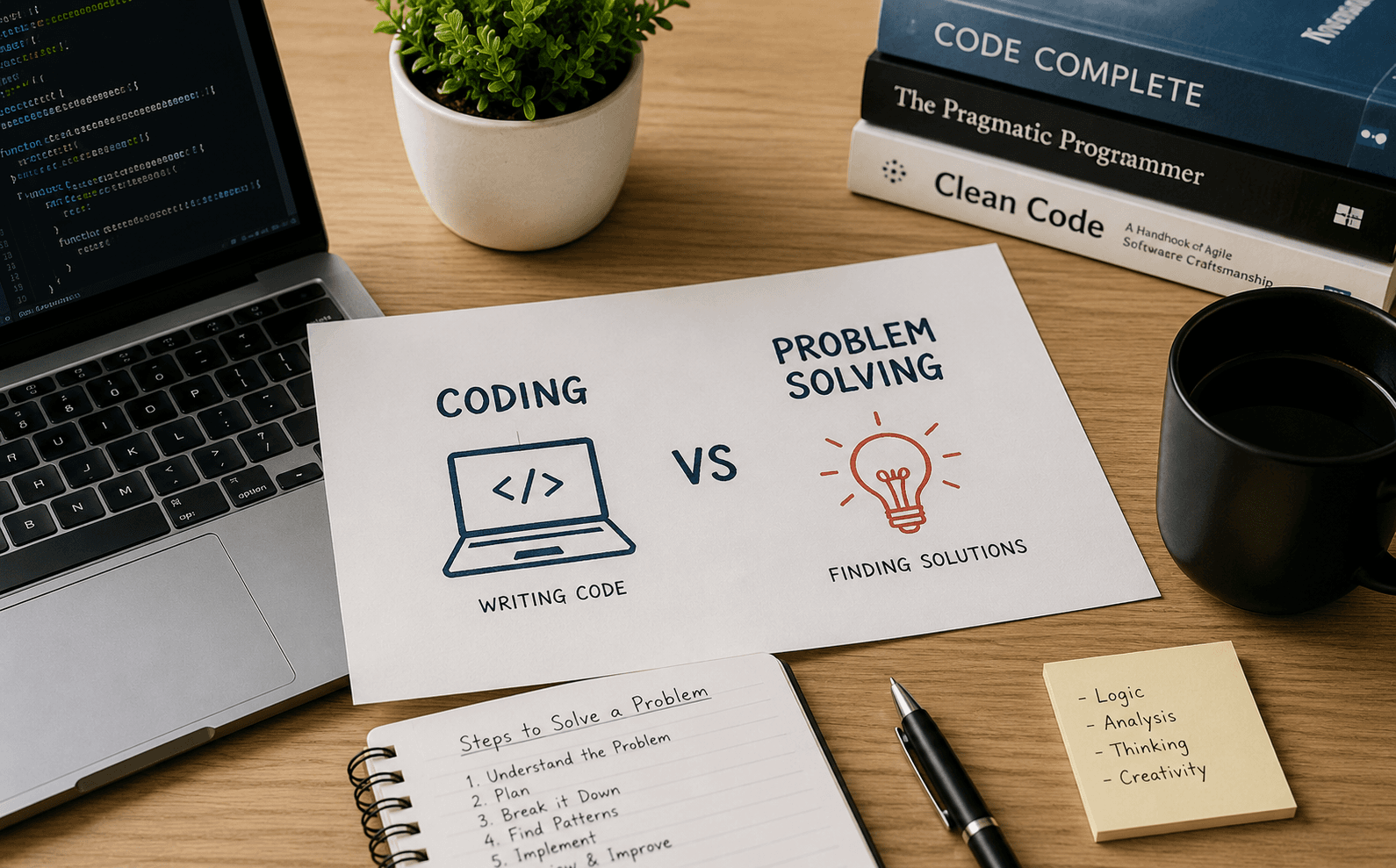
Whenever people start learning programming, one common question comes up: what actually matters more, coding or problem solving?
At first, coding feels like everything. You learn a language like Python, Java, or C++, practice syntax, build small projects, and feel productive. Writing lines of code gives visible results. It feels real. But after some time, you realize something interesting. The hardest part is usually not typing the code, it is figuring out what to type.
That is where problem solving comes in. Problem solving is about understanding what the actual issue is, breaking it into smaller pieces, thinking through different approaches, and choosing the best one. In many cases, once the logic is clear in your head, the coding part becomes much easier and faster.
This does not mean coding is less important. Without proper implementation, even the smartest idea stays stuck on paper. Writing clean, readable, and efficient code is a skill on its own. Poor coding can ruin a good solution.
However, coding can be learned with practice and repetition. Syntax, rules, and structures eventually become familiar. Problem solving, on the other hand, takes deeper thinking. It develops over time through experience, mistakes, and continuous learning. It is what helps you adapt when you face a completely new challenge.
So which matters more?
Both are essential. But if we have to choose, problem solving has a slight edge. Coding is the tool. Problem solving is the direction. Without direction, the tool does not do much.