


Full article
For the past few years, most people met AI through a chat window: you type a question, you get an answer. Useful, but limited. The real shift happening now is quieter and far more significant: AI is moving from answering to acting.
These systems are called AI agents, and they're changing how technical teams design, build, and ship products.
What Is an AI Agent, Really?
A chatbot responds. An agent pursues a goal.
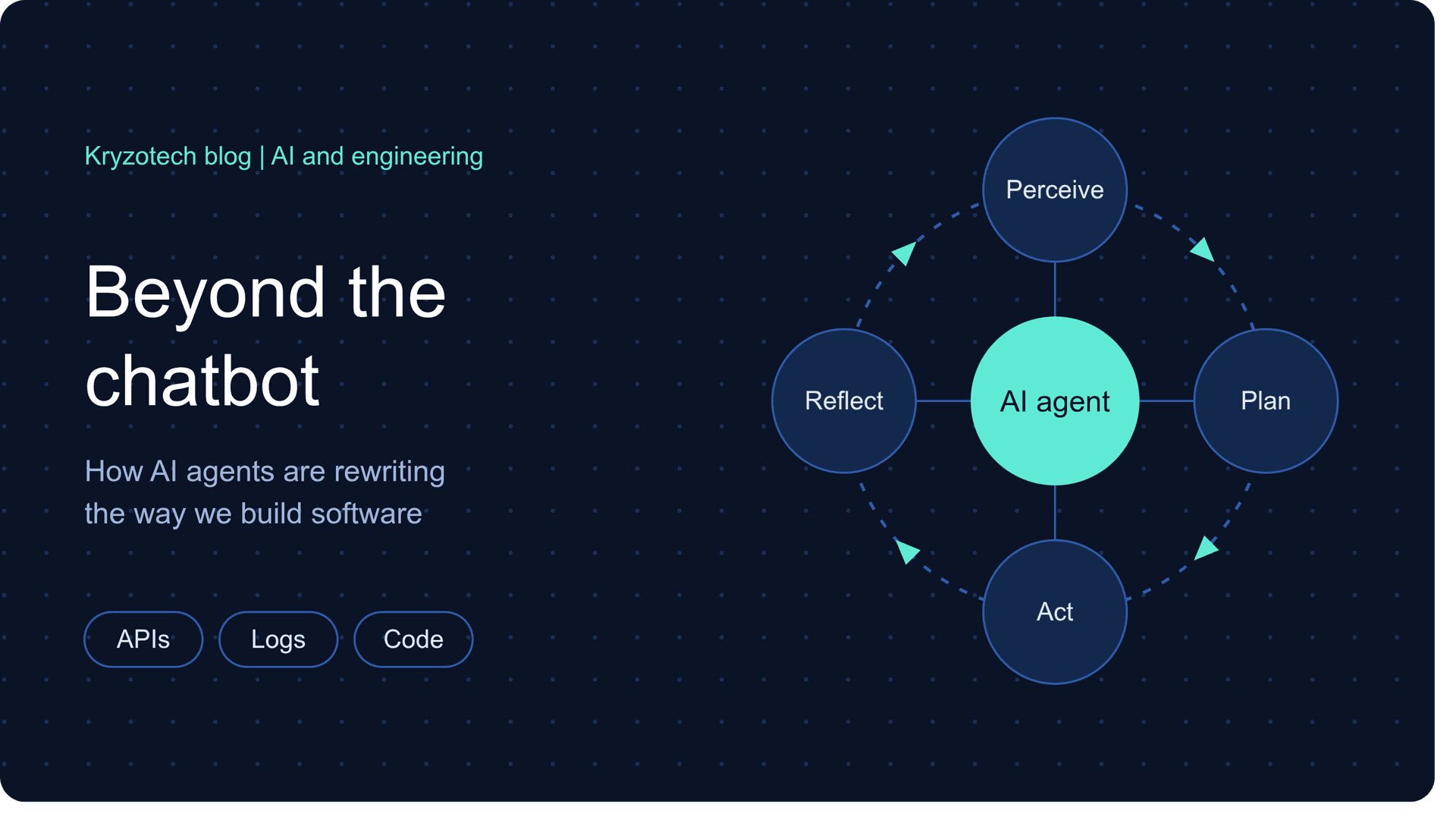
Give an agent a task like "find why our checkout latency spiked and propose a fix," and it can break the problem into steps, query logs, read code, run tests, and report back. The core loop looks like this:
- Perceive: gather context (code, data, documents, system state)
- Plan: decide which steps will reach the goal
- Act: use tools such as APIs, databases, and terminals
- Reflect: check results and adjust
The difference from traditional automation is flexibility. A script does exactly what you wrote. An agent adapts when something unexpected happens.
Where Agents Are Already Delivering Value
Software development. Agents can write boilerplate, generate tests, review pull requests, and help migrate legacy code. Engineers spend less time on repetitive work and more on architecture and product decisions.
Data and analytics. Instead of waiting on a report, teams can ask questions in plain language and get queries, charts, and summaries in minutes.
Operations and support. Agents triage incidents, summarize tickets, and draft responses, with a human approving anything high-stakes.
Knowledge work. Searching internal docs, summarizing long threads, and preparing briefs are tasks where agents save hours every week.
The Challenges Nobody Should Ignore
Powerful tools come with real risks. Teams adopting agents should plan for:
- Hallucinations. Models can state wrong things confidently. Critical outputs need verification.
- Security and permissions. An agent with broad access is a large attack surface. Apply least-privilege principles, just as you would for any new team member.
- Prompt injection. Malicious instructions hidden in emails, web pages, or documents can hijack an agent's behavior. Treat external content as untrusted.
- Cost and latency. Multi-step agent workflows can get expensive. Measure before you scale.
- Observability. If you can't trace why an agent did something, you can't debug or trust it. Log every step.
A Practical Playbook for Getting Started
You don't need a massive transformation project. A sensible path:
- Start with a narrow, low-risk use case, such as internal documentation search or test generation.
- Keep a human in the loop. Let the agent propose; let a person approve.
- Define success metrics up front: time saved, error rate, user satisfaction.
- Build evaluation early. Create a test set of real tasks and measure the agent against it regularly.
- Expand gradually. Once trust and data back it up, widen the scope and autonomy.
What This Means for Engineers
A common fear is that AI will replace developers. A more accurate picture: it raises the value of the skills that were always most important, such as system design, clear problem definition, critical review, and good judgment. The engineers who thrive will be the ones who learn to direct these tools well, not the ones who ignore them or trust them blindly.
The Bottom Line
AI agents aren't magic, and they aren't hype-only either. They're a new layer in the software stack: powerful when scoped well, risky when deployed carelessly. Organizations that experiment thoughtfully now, with guardrails and measurement, will be far better positioned as the technology matures.
At Kryzotech, we believe the best technology is the kind you can understand, trust, and control. The future of AI isn't about replacing people. It's about giving talented teams better tools to build what matters.
What's your team's first agent use case? Let us know.